Citrix now officially recommends Novell PlateSpin Recon

citrix logo

novell logo

At the beginning of March, Citrix and Novell started a new partnership on virtualization.
Both offer commercial grade hypervisors based on Xen, but Novell is extending its interest to KVM, following the rival Red Hat.

Despite the evident competition to win Linux shops, Novell agreed to provide joint technical support for customers running SLES on XenServer, and Citrix agreed to use PlateSpin Recon internally and across its Solutions Advisors partner network.

The deal works quite for Citrix which lacks capacity planning tools as part of its virtual infrastructure and may be not ready to acquire a startup in this space.
It works less well for Novell, which is certainly interested in pushing the PlateSpin business, but continues to give confusing messages about its hypervisor strategy.

Read more

Is Parallels working on hardware virtualization for the Apple iPad?

parallels logo

The interest around the new Apple iPad is over the top and, while US customers (rest of the world will have to wait another month) are enjoying over 1,000 applications already, most IT vendors are still evaluating if and how to deliver their solutions on the new gadget.

The screen real estate (9.7”) in fact makes the iPad more usable than the iPhone for a number of tasks, which may lead to a more concrete adoption beyond the consumer market.
One of these tasks for sure is server-based/thin computing, so it’s not a big surprise to see that both Citrix and Wyse literally rushed to deliver their Receiver and PocketCloud apps on iPad since day one.

An alternative approach to remote desktop to bring existing applications on the iPad of course would be hardware virtualization.

Read more

VMware releases ESX patch to improve performance, Project VRC rerun benchmarks

vmware logo

A few weeks ago VMware acknowledged a bug in ESX that translates into poor performance when it runs Microsoft Terminal Services workload on Intel 5500 (codename Nehalem) CPUs with Hyper-Threading (HT) enabled.

The issue emerged in independent benchmarks published with the Project Virtual Reality Check (VRC) framework and Citrix has been quick in suggesting that this demonstrates the flaws of the VMware EULA.

The founders of Project VRC rerun the benchmark with the patch and the results are considerably better.

Microsoft introduces beta support for 4 vCPUs Linux VMs

microsoft logo

Yesterday Microsoft has finally released a (beta) version of its Linux Integration Services for Hyper-V virtual machines that support multiple vCPUs.

Specifically, the new component introduces:

  • SMP support for Linux workloads
    Linux virtual machines running on Hyper-V will be able to use up to 4 virtual CPU’s
  • Timesync
    Linux VM’s running on Hyper-V will be able to synchronize their time with the parent partition
  • Integrated Shutdown
    You will be able to shut down a Linux virtual machine gracefully from the Hyper-V manager

Read more

Release: Red Hat Enterprise Linux 5.5

redhat logo

Along with the beta of the Enterprise Virtualization (RHEV) 2.2 platform, Red Hat also released Enterprise Linux (RHEL) 5.5 GA.

The new version of KVM included in the operating system introduces support improvements for the PCI passthrough technologies (AMD IOMMU and Intel VT-d) and two new features:

  1. Support for guest OS management through the Cluster Suite
  2. Support for Hugepages (4MB pages supported by Intel and newest AMD CPUs, also known as Page Size Extension)

The most interesting addition anyway is related to the SPICE components needed by the Enterprise Virtualization Manager for Desktops (REVMD) that just appeared in RHEV 2.2.

Read more

Release: Reflex Systems VMC 2.0 with vProfile

reflex logo

Last week Reflex Systems (formerly Reflex Security) introduced a new module called vProfile as part of its Virtualization Management Center (VMC) 2.0 launched in September 2009.

The company published an extensive explanation of how the new component works on its corporate blog:

vProfile is built entirely on top of the VQL language developed by Reflex. VQL provides a layer of abstraction from the database and the virtual infrastructure which makes it very simple to provide configuration management capabilities for anything that VQL can represent.

In the initial release of vProfile we support three major types of targets:

  1. VMS – A Virtualization Management Server such as the VMware vCenter product.
  2. Host – A physical Host running a hypervisor such as the VMware vSphere ESX or ESXi product.
  3. VM – A guest virtual machine running in a hypervisor

Read more

Release: RingCube vDesk 3.0

ringcube logo

RingCube is a US startup that launched in October 2006.
Its first product, MojoPac was an application virtualization solution targeting the mobile segment of the consumer market.

The company, which raised $16 million in two investment rounds, tried multiple strategies to boost adoption, including a business model sustained by advertising to give MojoPac away for free, without much success.
So, two years after the launch, RingCube decided to shift its focus on the business market, replacing MojoPac with a new product called vDesk.

vDesk acts like a wrapper for hosted virtualization platforms, which can enforce corporate security policies and that can be centrally managed. It competes against products like Microsoft MED-V (formerly Kidaro Workspaces), Sentillion vThere (acquired by Microsoft too) and VMware ACE. 

Read more

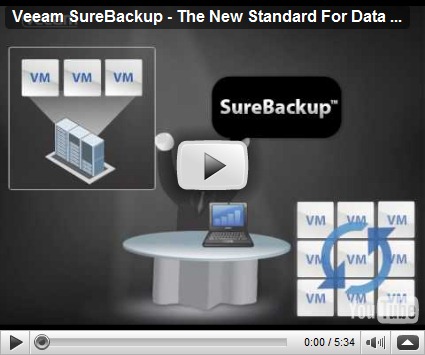
Video: Veeam SureBackup (with Recovery Verification)

veeam logo

Last week virtualization.info published an explanatory article about the new Veeam initiative dubbed SureBack and some of the upcoming feature that it will introduce.

Today we show a video of these features, namely Recovery Verification and Item-Level Recovery for Applications, that will arrive with Veeam Backup & Replication 5.0, expected in Q3 2010.

The video is also featured on our (beta) webTV: www.virtualization.tv

Red Hat looks at application virtualization, promotes InstallFree Bridge

redhat logo

installfree logo

Red Hat signed a partnership with the Israeli startup InstallFree in H1 2009, but so far the company didn’t push too much the idea of application virtualization and VDI together.

InstallFree launched in April 2008, when the application virtualization market was already under consolidation thanks to the acquisitions of Microsoft, Symantec and VMware.

Bridge is able to create autonomous (agent-less) virtual applications which can be updated or incrementally patched without the need to re-virtualize them.
The customizations that users may decide to apply to a virtualized app are saved in dedicated encrypted files, which can be saved and redistributed, and which are not impacted when the application is updated.
Additionally, InstallFree offers a centralized management console, which fully integrates with Microsoft Active Directory, and uses it to distribute the virtual apps to corporate users.

Read more

Red Hat launches Enterprise Virtualization 2.2 beta, includes VDI management

redhat logo

Yesterday Red Hat announced the beta program of the Red Hat Enterprise Virtualization (RHEV) platform 2.2.

The company CEO hinted at this new update in the recent earning calls where he discussed about market opportunities against VMware.

Red Hat introduced the RHEV infrastructure in November 2009.
At that time only two components were unveiled: the Enterprise Virtualization Hypervisor (REVH), a stripped down version of RHEL 5.4, and the Enterprise Virtualization Manager for Server (REVMS). 
The missing piece, coming from the acquisition of Qumranet in September 2008, dubbed Enterprise Virtualization Manager for Desktops (REVMD), arrives only now, in this new beta.

REVMD (formerly Qumranet Solid ICE) supports several features, including of course the Qumranet SPICE remoting protocol:

Read more