Microsoft introduces beta support for 4 vCPUs Linux VMs

microsoft logo

Yesterday Microsoft has finally released a (beta) version of its Linux Integration Services for Hyper-V virtual machines that support multiple vCPUs.

Specifically, the new component introduces:

  • SMP support for Linux workloads
    Linux virtual machines running on Hyper-V will be able to use up to 4 virtual CPU’s
  • Timesync
    Linux VM’s running on Hyper-V will be able to synchronize their time with the parent partition
  • Integrated Shutdown
    You will be able to shut down a Linux virtual machine gracefully from the Hyper-V manager

Read more

Release: Red Hat Enterprise Linux 5.5

redhat logo

Along with the beta of the Enterprise Virtualization (RHEV) 2.2 platform, Red Hat also released Enterprise Linux (RHEL) 5.5 GA.

The new version of KVM included in the operating system introduces support improvements for the PCI passthrough technologies (AMD IOMMU and Intel VT-d) and two new features:

  1. Support for guest OS management through the Cluster Suite
  2. Support for Hugepages (4MB pages supported by Intel and newest AMD CPUs, also known as Page Size Extension)

The most interesting addition anyway is related to the SPICE components needed by the Enterprise Virtualization Manager for Desktops (REVMD) that just appeared in RHEV 2.2.

Read more

Release: Reflex Systems VMC 2.0 with vProfile

reflex logo

Last week Reflex Systems (formerly Reflex Security) introduced a new module called vProfile as part of its Virtualization Management Center (VMC) 2.0 launched in September 2009.

The company published an extensive explanation of how the new component works on its corporate blog:

vProfile is built entirely on top of the VQL language developed by Reflex. VQL provides a layer of abstraction from the database and the virtual infrastructure which makes it very simple to provide configuration management capabilities for anything that VQL can represent.

In the initial release of vProfile we support three major types of targets:

  1. VMS – A Virtualization Management Server such as the VMware vCenter product.
  2. Host – A physical Host running a hypervisor such as the VMware vSphere ESX or ESXi product.
  3. VM – A guest virtual machine running in a hypervisor

Read more

Release: RingCube vDesk 3.0

ringcube logo

RingCube is a US startup that launched in October 2006.
Its first product, MojoPac was an application virtualization solution targeting the mobile segment of the consumer market.

The company, which raised $16 million in two investment rounds, tried multiple strategies to boost adoption, including a business model sustained by advertising to give MojoPac away for free, without much success.
So, two years after the launch, RingCube decided to shift its focus on the business market, replacing MojoPac with a new product called vDesk.

vDesk acts like a wrapper for hosted virtualization platforms, which can enforce corporate security policies and that can be centrally managed. It competes against products like Microsoft MED-V (formerly Kidaro Workspaces), Sentillion vThere (acquired by Microsoft too) and VMware ACE. 

Read more

Video: Veeam SureBackup (with Recovery Verification)

veeam logo

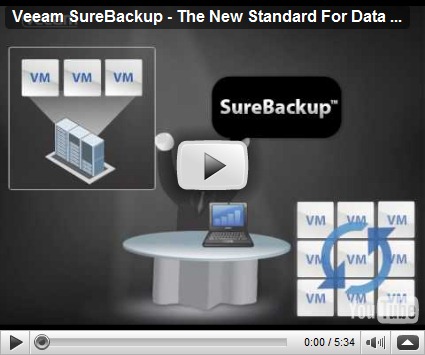
Last week virtualization.info published an explanatory article about the new Veeam initiative dubbed SureBack and some of the upcoming feature that it will introduce.

Today we show a video of these features, namely Recovery Verification and Item-Level Recovery for Applications, that will arrive with Veeam Backup & Replication 5.0, expected in Q3 2010.

The video is also featured on our (beta) webTV: www.virtualization.tv

Red Hat looks at application virtualization, promotes InstallFree Bridge

redhat logo

installfree logo

Red Hat signed a partnership with the Israeli startup InstallFree in H1 2009, but so far the company didn’t push too much the idea of application virtualization and VDI together.

InstallFree launched in April 2008, when the application virtualization market was already under consolidation thanks to the acquisitions of Microsoft, Symantec and VMware.

Bridge is able to create autonomous (agent-less) virtual applications which can be updated or incrementally patched without the need to re-virtualize them.
The customizations that users may decide to apply to a virtualized app are saved in dedicated encrypted files, which can be saved and redistributed, and which are not impacted when the application is updated.
Additionally, InstallFree offers a centralized management console, which fully integrates with Microsoft Active Directory, and uses it to distribute the virtual apps to corporate users.

Read more

Red Hat launches Enterprise Virtualization 2.2 beta, includes VDI management

redhat logo

Yesterday Red Hat announced the beta program of the Red Hat Enterprise Virtualization (RHEV) platform 2.2.

The company CEO hinted at this new update in the recent earning calls where he discussed about market opportunities against VMware.

Red Hat introduced the RHEV infrastructure in November 2009.
At that time only two components were unveiled: the Enterprise Virtualization Hypervisor (REVH), a stripped down version of RHEL 5.4, and the Enterprise Virtualization Manager for Server (REVMS). 
The missing piece, coming from the acquisition of Qumranet in September 2008, dubbed Enterprise Virtualization Manager for Desktops (REVMD), arrives only now, in this new beta.

REVMD (formerly Qumranet Solid ICE) supports several features, including of course the Qumranet SPICE remoting protocol:

Read more

VMware introduces named user license in ThinApp 4.5

vmware logo

In mid-March virtualization.info covered the release of VMware ThinApp 4.5
A key thing we overlooked is the change in the end user license agreement, which the company highlighted in a recent post:

you can license a device or a named user. If you have 50 devices but 100 users you use 50 client devices. If you have 50 users but they use many different clients (desktop, laptop and Citrix sessions) you still only needs 50 licenses (named user method of license).
There are not two different licenses that you can buy. You buy one license for a device and this could either be used to license a device or a named user.

vSphere 4.0 Update 2 to add new HA features

vmware logo

YellowBricks just hinted at a new VMware HA feature that will appear in vSphere 4.0 Update 2:

4 Hosts – iSCSI / NFS based storage – Isolation response: leave powered on

When one of the hosts is completely isolated, including the Storage Network, the following will happen:

Host ESX001 is completely isolated including the storage network(remember iSCSI/NFS based storage!) but the VMs will not be powered off because the isolation response is set to “leave powered on”. After 15 seconds the remaining, non isolated, hosts will try to restart the VMs. Because of the fact that the iSCSI/NFS network is also isolated the lock on the VMDK will time out and the remaining hosts will be able to boot up the VMs. When ESX001 returns from isolation it will still have the VMX Processes running in memory. This is when you will see a “ping-pong” effect within vCenter, in other words VMs flipping back and forth between ESX001 and any of the other hosts.

As of version 4.0 ESX(i) detects that the lock on the VMDK has been lost and issues a question if the VM should be powered off or not. Please note that you will(currently) only see this question if you directly connect to the ESX host. Below you can find a screenshot of this question.

With ESX 4 update 2 the question will be auto-answered though and the VM will be powered off to avoid the ping-pong effect and a split brain scenario

Xen.org looks for more developers for Hosted Xen for Windows and Mac OS

xen logo

In March 2009 virtualization.info reported that Citrix was working on a hosted version of XenServer, dubbed XenWorkstation. Apparently, we were wrong (or Citrix decided to indefinitely postpone it, as some sources report).

What really happened, in April 2009, is that Xen.org announced the open source project Hosted Xen (HXEN): a type-2 (hosted) virtual machine monitor (VMM) that runs on 32bit versions of Windows (XP, Vista and 7) and Mac OS .

The HXEN code is a snapshot of the Xen code base used in XenServer and nothing stops Citrix from adding its own code and market the product as XenWorkstation.

Read more